
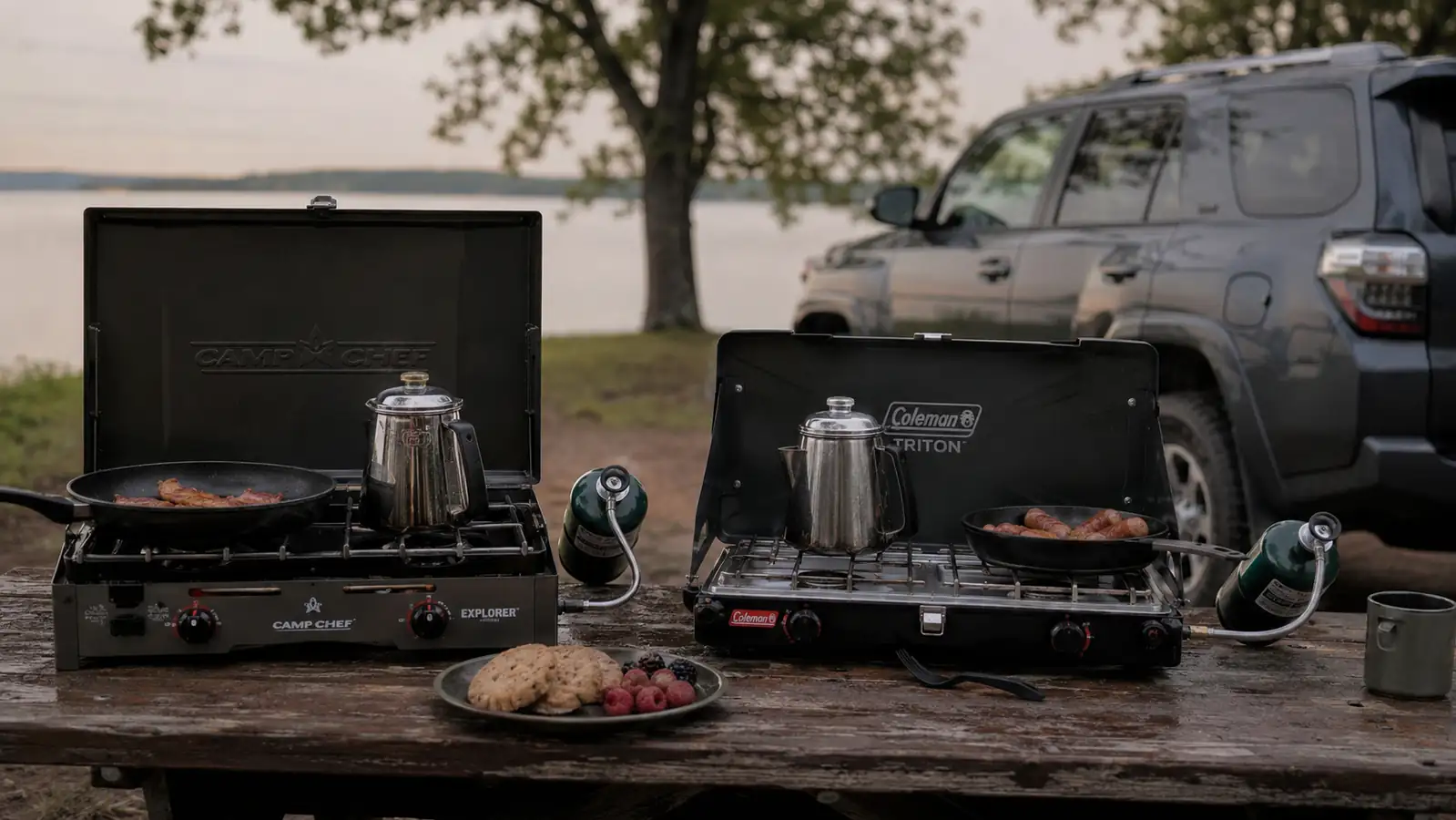
Kyle showed up to our Lake Tenkiller weekend last month hauling a Camp Chef Explorer 2-Burner instead of borrowing my Coleman Triton+ like he usually does, and I figured that was as good an excuse as any to actually put the two stoves side by side instead of arguing about it over text. Same picnic table, same Saturday morning, same order of business, bacon first, then pancakes, then eggs while the kids circled the table asking how much longer.
Short answer up front: for weekend trips inside about a four hour drive from northeast Oklahoma, one SUV, and a family that wants breakfast moving fast, the Coleman Triton+ wins on packed size, wind resistance, and ignition reliability. The Camp Chef Explorer wins on raw burner output and total cook surface if you've got the cargo room and you're feeding a bigger crew for more than a weekend. Here's how they actually stacked up cooking the same meal.
| Coleman Triton+ 2-Burner | Camp Chef Explorer 2-Burner | |
|---|---|---|
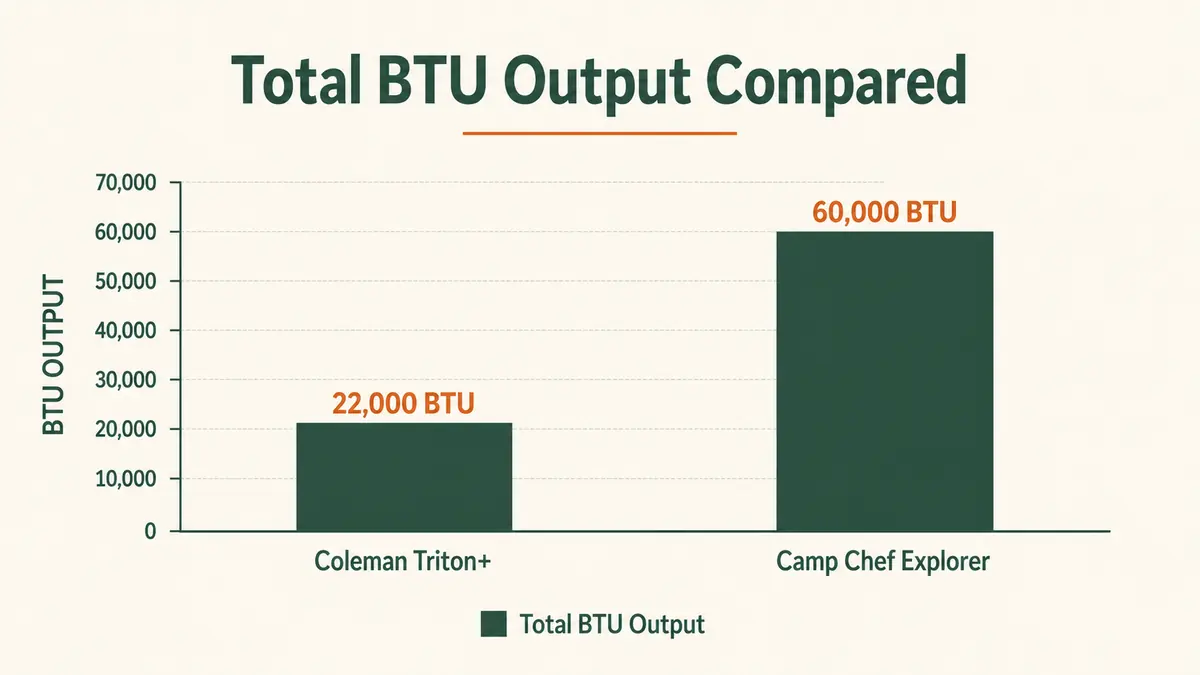
| Total BTU Output | 22,000 BTU combined, 11,000 per burner, adjustable low simmer | 60,000 BTU combined, 30,000 per burner, runs hotter but harder to hold a low simmer |
| Ignition | InstaStart push-button piezo, lit every time we tried it including a damp morning | Manual match-light, no built-in igniter on the base model |
| Fuel Source | 16.4 oz propane canister, screws directly into the stove | 20 lb propane tank, connects with a hose sold separately from the stove |
| Wind Guards | Integrated 3-sided fold-up wind guard built into the case | No wind guard included, needs an add-on box or a windbreak of your own |
| Packed Weight | About 12 pounds | About 20 pounds |
| Packed Size | 21.5 x 15 x 5.3 inches, fits flat under the 4Runner's cargo cover | 27.5 x 15.5 x 6 inches, too wide to fit flat under the same cargo cover |
| Cook Surface | 319 square inches, fits two mid-size pans side by side | 386 square inches, fits a full cast iron skillet plus a stockpot |
| Price at Publish | Runs close to today's Amazon price, well under the Explorer once you add a hose | Runs noticeably higher, and that's before buying a 20 lb tank and hose adapter |
| Best For | Weekend car camping, fast basecamp breakfasts, one SUV of cargo space | Extended basecamp cooking, bigger groups, sites with room to spare |
How I Tested Both Stoves
We set both stoves up on the same picnic table at our Lake Tenkiller site, ran them off fresh fuel, and cooked the exact same breakfast on each one back to back so neither stove got an easier job than the other. Bacon first on medium heat, then pancakes on the second burner while the bacon finished, then scrambled eggs to close it out. I clocked ignition time, watched how each flame handled the morning breeze coming off the water, and paid attention to how evenly the heat spread across a full skillet instead of just trusting the BTU number on the box.
Nolan and Ivy acted as the least patient quality control team you could ask for, since neither one wanted to wait an extra five minutes for food because a stove wouldn't light. That's honestly the most useful pressure test I've found for camp gear. A stove that performs fine in a controlled backyard demo but fumbles the ignition on a cool, damp morning with two hungry kids standing around is a stove that's going to earn some complaints on a real trip, no matter what the spec sheet says.
I also ran both stoves again the next morning without an audience, just to make sure the first result wasn't a fluke or a case of Kyle's tank being low. Same outcome both times. The Coleman Triton+ lit on the first press of the button, and the Camp Chef Explorer needed a lighter and a little patience before the left burner caught. That consistency across two mornings is what convinced me this wasn't a one-off, it's just how these two stoves behave.
Where the Coleman Triton+ Wins
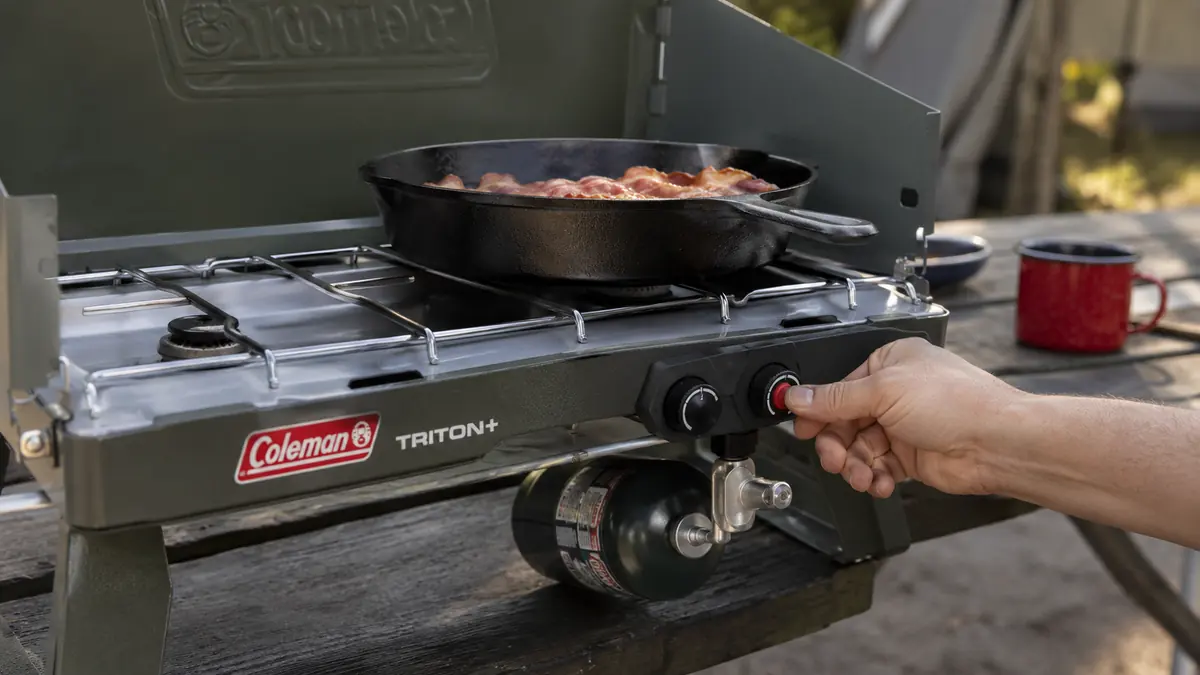
The InstaStart ignition is the first thing that separated the two stoves that morning. It had rained overnight at Lake Tenkiller and everything at the site was damp, the picnic table, the tent stakes, my hands. I pressed the button on the Coleman Triton+ and both burners lit on the first try, same as every other trip I've taken it on this season. Kyle spent close to a minute flicking a butane lighter at the Camp Chef's left burner before it caught, cupping his hand around the flame to block a breeze that wasn't even that strong.
That breeze mattered more than either of us expected. The Coleman Triton+ has a wind guard built right into the case, three panels that fold up around the burners without any extra setup. The Camp Chef Explorer doesn't come with one at all, so Kyle's flame kept guttering while my bacon cooked steady the whole time. By the time his second burner lit, I already had the first batch of pancakes flipped.
Packed size is the other place the Coleman Triton+ pulls ahead for a family running one SUV. It fits flat under the cargo cover in the 4Runner, right alongside the cooler and the tent duffel, without stealing space that Dana and I need for everything else. The Camp Chef's wider footprint didn't fit under Kyle's cover at all, so it rode loose on top of his gear, which meant everything else had to get repacked around it.
The low simmer adjustment on the Triton+ is something I didn't fully appreciate until that morning either. Pancake batter needs a burner that can hold steady at a medium-low heat without scorching the first one while you're still pouring the second. I could dial that in easily on the Coleman side. Kyle had a harder time keeping his higher-output burner low enough, and his first pancake came out darker on one edge before he adjusted.
Where the Camp Chef Explorer Wins
I'll give the Camp Chef its due, because 60,000 combined BTU is a real difference once you're cooking for more than four people. When Kyle finally got both burners going, he had a stockpot of chili and a full cast iron skillet running at the same time without either one fighting the other for heat. My Coleman Triton+ can technically hold two pans, but a full skillet and a stockpot together push it, and I noticed the second burner sagging a little on output when I tried the same setup at home.
The bigger cook surface matters for the same reason. At 386 square inches, the Explorer had room for gear that just doesn't fit comfortably on the Triton+'s 319 square inches. If you're basecamping with two families instead of one, or you're the person who ends up cooking dinner for a scout troop, that extra real estate on the Camp Chef stops being a nice-to-have and starts being the reason you'd choose it over a smaller stove.
There's also something to be said for a stove built around a full-size 20 lb tank if you're already set up that way. Kyle never has to think about running out of fuel mid-meal the way I sometimes catch myself eyeing a half-empty 16.4 oz canister and doing math about whether it'll make it through Sunday breakfast too. For a longer stay at a site with room to spare, that's a legitimate advantage on the Camp Chef's side of the table.
Both stoves cooked a fine breakfast. Only one of them lit on the first try in the rain.
Lit every time, even on a wet Lake Tenkiller morning
For weekend trips where breakfast needs to happen fast and the stove has to fit in an already full SUV, the Coleman Triton+ is the one I reach for. Check today's price and current stock on Amazon.
Amazon Check Today's Price on Amazon →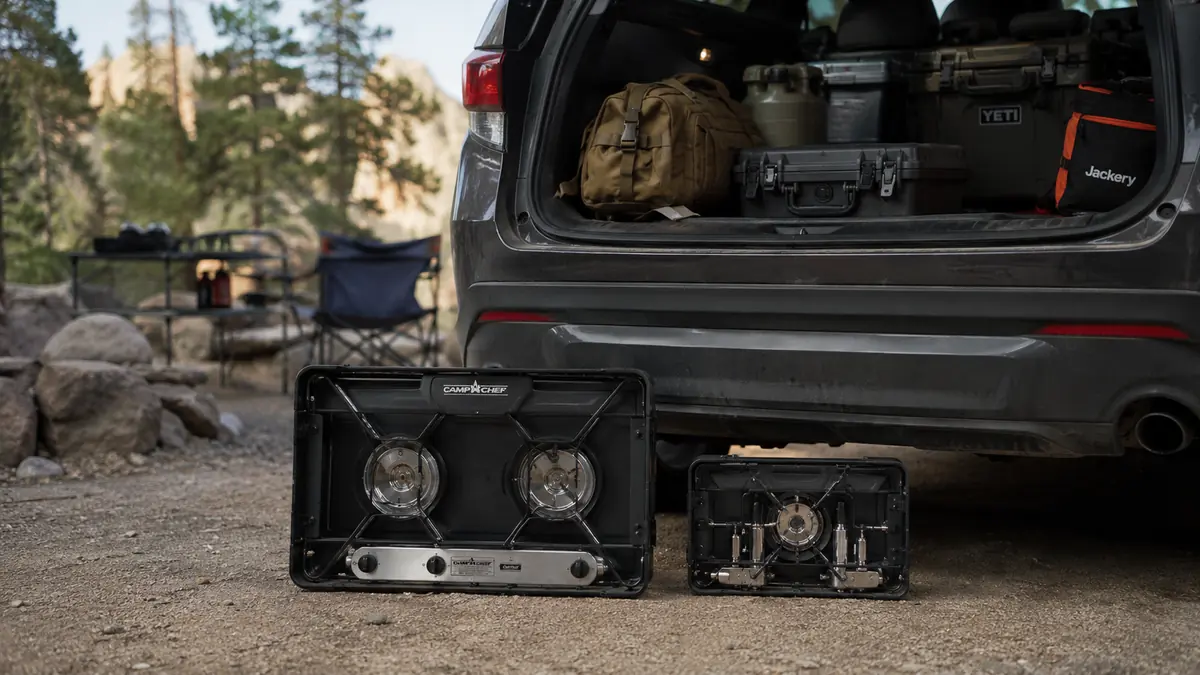
Fuel Logistics for a Weekend Trip
This is the part that never shows up in a spec sheet comparison but changes how a stove actually lives in your camping setup. The Coleman Triton+ screws directly onto a 16.4 oz propane canister, the same small green bottles most of us already keep a couple of in the garage for a lantern or a backup grill. Grab two, toss them in a side pocket of the cooler bag, done.
The Camp Chef Explorer needs a 20 lb propane tank and a hose adapter that doesn't come in the box. Kyle keeps his hooked up to the same tank he uses for his home grill, which works fine if you remember to disconnect it and haul the tank along, but it's one more heavy, awkward item taking up cargo space that the Coleman Triton+ just doesn't ask for. For a family packing a 4Runner with a tent, a cooler, sleeping bags, and two kids' worth of gear, that difference adds up fast.
There's a cost angle here too, and it's easy to miss if you're only comparing the sticker price of the two stoves. The Camp Chef Explorer's listed price doesn't include the tank or the hose, both of which you'll likely need to buy separately if you don't already own them. Factor those in and the gap between what you actually spend to get either stove cooking widens well past what the box price suggests.
Cleanup told a similar story to setup. The Coleman Triton+'s grates lift off and wipe down in a minute or two, and the drip tray underneath catches most of the bacon grease before it hits the picnic table. The Camp Chef's grates are heavier cast iron, which holds heat longer for searing but takes more scrubbing to keep from rusting if you pack it away damp. Kyle admits he's let his sit a season without a good scrub down, and it shows more wear on the burner heads than my Triton+ does after roughly the same amount of use.
Who Should Buy Which
If you camp like we do, weekend trips within a four hour drive, one SUV, breakfast that needs to happen before the kids melt down, the Coleman Triton+ is the easier stove to live with. It lights every time, it fits where the Camp Chef won't, and it doesn't ask you to haul a 20 lb tank along for the ride. For our trips, it's the one that stays packed in the 4Runner between weekends.
If you're basecamping for several nights, cooking for a bigger group, or you already run a 20 lb tank off your home grill and don't mind the extra bulk, the Camp Chef Explorer's higher output and bigger cook surface earn their keep. Just know going in it needs its own hose and tank, it won't fit flat under most SUV cargo covers, and you'll want a windbreak on anything but a still morning.
Still the stove that starts breakfast on time
After cooking the same meal on both stoves at the same campsite, the Coleman Triton+ still won on the things that matter most for a weekend trip. See today's price on Amazon.
Amazon Check Today's Price on Amazon →